Gardening Services Blackwall: Recycling and Sustainability Commitment
At Gardening Services Blackwall we believe that a tidy garden should go hand-in-hand with a healthy planet. This page outlines how our eco-friendly waste disposal area and sustainable rubbish gardening area strategies reduce landfill, support local reuse and align with the boroughs' approach to waste separation. Our green promise is practical: we minimise waste on site, maximise material recovery and design every job to prioritise reuse and recycling.

Our targets and measurable goals
We set a clear recycling percentage target: 75% of all garden waste and associated materials diverted from landfill by 2028, rising to 85% for routine green waste collections. This target applies across garden clearances, landscaping projects and routine lawn and hedge maintenance. To achieve it we separate materials on-site, use designated recycling trailers and record volumes so that each job contributes to our annual sustainability report. Our approach reflects nearby council schemes where glass, paper, food waste and separate green bins are encouraged and often collected separately by the local authority.
Local transfer stations and responsible routing
We work with approved local transfer stations and recycling centres in Tower Hamlets and neighbouring boroughs to ensure materials are processed correctly. Typical transfer destinations include municipal composting facilities, wood recycling yards and household recycling centres that accept inert soils and rubble. Where borough guidance allows, we use local green waste facilities to avoid long-distance haulage — reducing carbon and supporting the local circular economy. Our drivers log trips so we can prioritise the lowest-emission route and the nearest permitted transfer station.
Partnerships with charities and community reuse projects are central to our sustainable rubbish gardening area plan. Where plants, pots, tools and salvageable timber are in reusable condition we coordinate with local charities and community gardens to divert items from waste streams. These collaborations help community allotments, school garden projects and social enterprises and reflect our belief that valuable materials should get a second life before any recycling or disposal step.
Our fleet includes low-carbon vans and hybrid vehicles for routine rounds, plus battery-powered tools on many sites to reduce noise and emissions. We regularly upgrade vehicles to cleaner Euro 6 engines and increase electric van use as infrastructure allows. These investments directly support an eco-friendly waste disposal area approach by cutting emissions during collection and transfer.
We also run staff training on waste separation and site management so that every crew member knows how to sort: green waste, woody biomass, soil and turf, recyclable containers and non-recyclable rubbish. By improving segregation at source we increase recycling rates and reduce contamination of recyclable loads.
Operationally, our sustainable rubbish gardening area uses a clear classification system on site. Items are placed in labelled bays: compostables, mulching wood, reusable structures, recyclable plastics and residual waste. This minimises double-handling and speeds transfer to local centres. In some boroughs, kerbside separation includes separate food and garden collections; we mirror those principles on private sites to keep streams clean and compliant.
 We publish an annual waste breakdown showing the percentages allocated to reuse, composting, recycling and energy recovery. Typical activities include:
- Composting – turning green waste into soil improver or mulch for reuse in planting.
- Wood recycling – chipping larger branches for mulch, biomass or local arbor runs.
- Material rehoming – donating pots, timber and tools to partner charities.
- Separate soil handling – screening and reusing clean excavated soils where permitted.
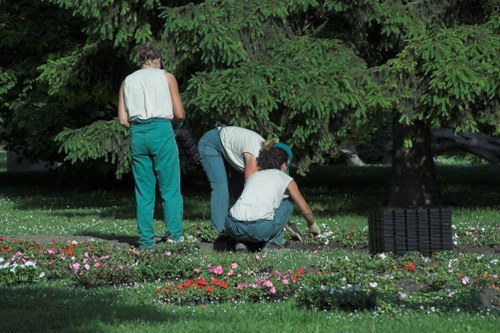
Small changes on-site—such as using fewer single-use plastic bags for green waste, preferring jute or compostable sacks, and planning for correct container sizing—have large cumulative effects.
For clients seeking an eco-conscious garden services Blackwall option we provide transparent job estimates that include a waste plan: what will be reused, recycled, composted or taken to transfer stations. All waste is documented and assigned to the correct disposal or reuse stream so that progress against our recycling percentage target is verifiable.
Our commitment to a sustainable future is ongoing: we continually review partnerships with charities, community groups and local recycling facilities to expand reuse opportunities. By combining careful on-site sorting, a low-carbon fleet, recorded routing to local transfer stations and strong charity connections, Gardening Services Blackwall aims to be a regional leader in eco-friendly garden waste management and the sustainable rubbish gardening area model for urban gardens.
Choose responsible garden care: our services balance beautiful outdoor spaces with environmental stewardship — reducing waste, supporting local reuse schemes and cutting emissions for every job.